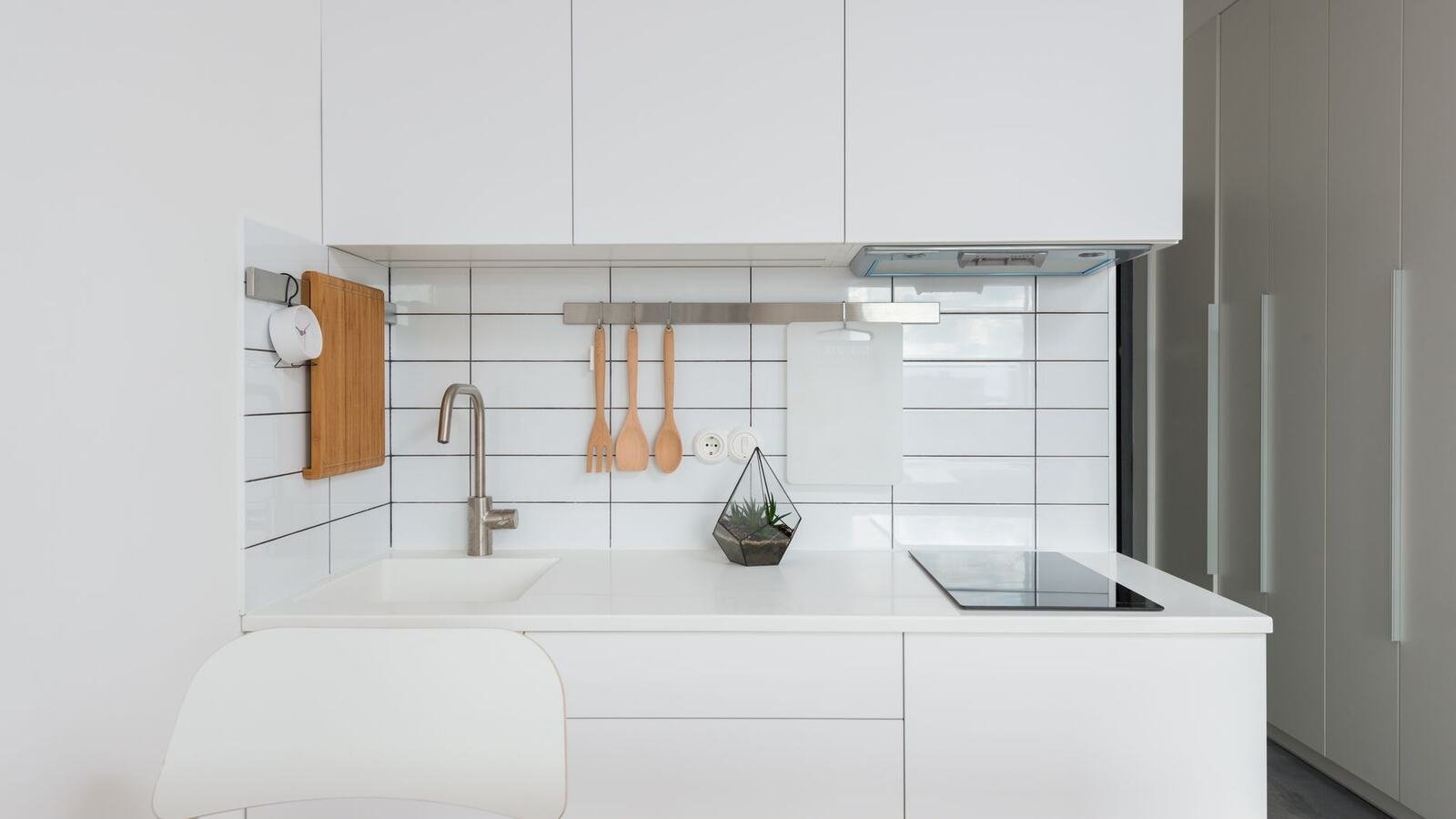
Kitchen wall cladding and splashbacks
The wall between worktop and wall units takes grease, steam and knocks every day. It is where a cheap material shows first.
- 48 h
- Fixed written quote within 48 h
- 0 €
- Free site visit
- 1
- How we work
- ★ 5,0
- Google · 13
Short answer
Which kitchen cladding is best?
Large-format porcelain or toughened glass, because neither has joints and both clean the same way after five years as on day one. Ceramic tile with epoxy grout is the balanced choice when budget governs — epoxy costs a little more than cement grout and stops the darkening that makes tiled splashbacks age badly. Ceramic tile starts at €42/m², epoxy-grouted tile at €55/m², large-format porcelain at €95/m² and toughened glass at €180/m². The cladding itself is normally done within a kitchen refit, from €4,500 and 12–25 working days on site.
The real difference between materials is not appearance. It is how many joints they have and how the grease behaves after two years.
| Material | Joints | From | Weak point |
|---|---|---|---|
| Ceramic tile | Many | €42/m² | Cement grout absorbs grease and darkens |
| Ceramic tile, epoxy grout | Many, sealed | €55/m² | Needs a competent tiler; little else |
| Large-format porcelain | None | €95/m² | Demands a very flat substrate |
| Toughened lacquered glass | None | €180/m² | Made to exact size — no correction later |
| Microcement | None | €110/m² | Staining if sealing is wrong; hard to patch |
| Laminate or compact panel | Few | Quoted on survey | Steam attacks the edges near the hob |
How each behaves in use
- Tile: cheapest and easy to replace a broken piece, but the grout lines are the weakness
- Large-format porcelain: a single sheet across the whole splashback, the cleanest option over time
- Toughened glass: wipes down in one pass, any colour, cut-outs drilled at the factory
- Microcement: seamless and contemporary, but needs correct sealing and a specialist hand
- Compact panel: installed in a day with no wet trade, useful in rental flats and partial refits
Technical
The three points where a splashback fails
Almost every problem shows up in the same three places, and all three are decided by workmanship rather than material.
The critical junctions
- Worktop junction: needs a flexible joint, neutral anti-mould silicone, never rigid grout
- Behind the hob: material that takes direct heat, which matters most with gas
- Around the sink: where water gets in behind if the seal fails
How high it should go
The splashback zone between worktop and wall units is normally 55–60 cm. Where there are no units above, continue the cladding to the ceiling: stopping it half way up leaves an exposed edge that collects grime and reads as unfinished. In flats with three-metre ceilings that is a larger area than people expect, and it belongs in the quote from the start.
Cladding over the existing finish
Sometimes possible, if the old tile is soundly bonded and flat. You lose some depth and every junction — worktop, sockets, window reveal — has to be resolved for the new thickness. We assess it on the survey; on an out-of-square period wall it is often quicker to strip back.
Choosing and coordinating
What to pick, and how it works from a distance
If you cook a lot
Large-format porcelain or glass. No joints is the only way it still cleans as easily in five years, and it is the difference you notice most in a kitchen used every day rather than at weekends.
If the budget governs
Ceramic tile with epoxy grout. It costs a little more than standard grout and removes the darkening that ages a tiled splashback badly.
If you want visual continuity
Microcement, or porcelain carried up from the worktop in the same material. It is the finish that makes a small kitchen feel largest, which is most Barcelona kitchens.
If the works are quick
Compact panel: installed in a single day, no wet trade and no drying time. Practical for a rental flat between tenancies.
Ordering it while you are abroad
Glass and porcelain are cut to measured size with the socket and tap cut-outs made at the factory, so the survey has to be exact and nothing can be adjusted on site. We send you the setting-out with cut-out positions to approve in writing before ordering. A kitchen splashback is internal work under a prior notification, with no communal element and therefore no comunidad approval or derrama involved — only the building’s working hours and lift access to agree with the administrator.
Frequently asked
What clients ask most
Large-format porcelain or toughened glass, because they have no joints and clean as easily after five years as at the start. Ceramic tile with epoxy grout is the balanced option when budget matters most.
Conventional cement grout is porous and absorbs grease and steam, so it darkens. Epoxy grout removes the problem almost entirely and costs only a little more.
At least the 55–60 cm between worktop and wall units. Where there are no units above, take it to the ceiling — stopping half way leaves an exposed edge that collects grime and looks unfinished.
Sometimes, if the existing tile is soundly bonded and flat. You lose depth and every junction has to be resolved for the new thickness. On out-of-square period walls stripping back is often faster.
Yes, but the survey must be exact: glass and porcelain are cut to size with cut-outs made at the factory and cannot be adjusted on site. We send the setting-out with cut-out positions for your written approval before ordering.

Next step
Shall we talk about your project?
Free site visit in Barcelona and the metropolitan area. Fixed written quote within 48 hours, no obligation.
Before you decide
Practical guides
Real prices, permits and how a project runs when you live abroad. So you can compare quotes knowing what you are looking at.
Areas
Where we work
Other services
We also do
Blog
What we learn on site
Real housing problems in Barcelona, explained by the people who fix them.
Room dividers
Separating without closing is the most requested move in flat renovations. The right question is not which divider looks best, but what you actually need to separate: sight, sound or both.
Walk-in wardrobe
An undersized walk-in wardrobe is worse than a good fitted one: it takes metres off the bedroom without adding capacity. These are the numbers below which it stops making sense.
Piso diafano
Diafano is the most used word in Spanish property listings and the least understood by foreign buyers. It means free of obstacles — a space without internal partitions — and it can describe two very different things.
Clients
What clients say after their renovation
Rated 5.0 from 14 Google reviews. All real, from real projects.
★★★★★
“Doy un 10 la verdad con el servicio que me han prestado en una reforma de un piso en Barcelona capital, gente muy seria y responsable, gracias.”
Araks SahakyanJuly 2026
★★★★★
“Quedé encantada con la atención y la calidad del trabajo. Se nota que cuidan los detalles y cumplen con lo que prometen.”
Ana RiveraApril 2026
★★★★★
“Servicio muy profesional. Me explicaron todo con claridad y el trabajo quedó perfecto.”
Ana AlemanMarch 2026
★★★★★
“Si estas buscando profesionales responsables para hacer tu reforma, es el lugar indicado. Especializados en reformas integrales con la mejor atención personalizada. 100% recomendados.”
Daniel GarganoFebruary 2026
★★★★★
“Muy buen trabajo, ha realizado un trabajo muy profesional, ha cumplido en plazo y en calidad.”
Francisco PiñeirosAugust 2025
★★★★★
“Muy buenos profesionales, con excelente resultado.”
Esther DiezJune 2026
Shall we talk about your project?
Free technical visit in Barcelona and the metropolitan area. Fixed written quote within 48 hours.
+34 615 78 93 41· Carrer de la Diputació, 189, Local 2 · 08011 Barcelona