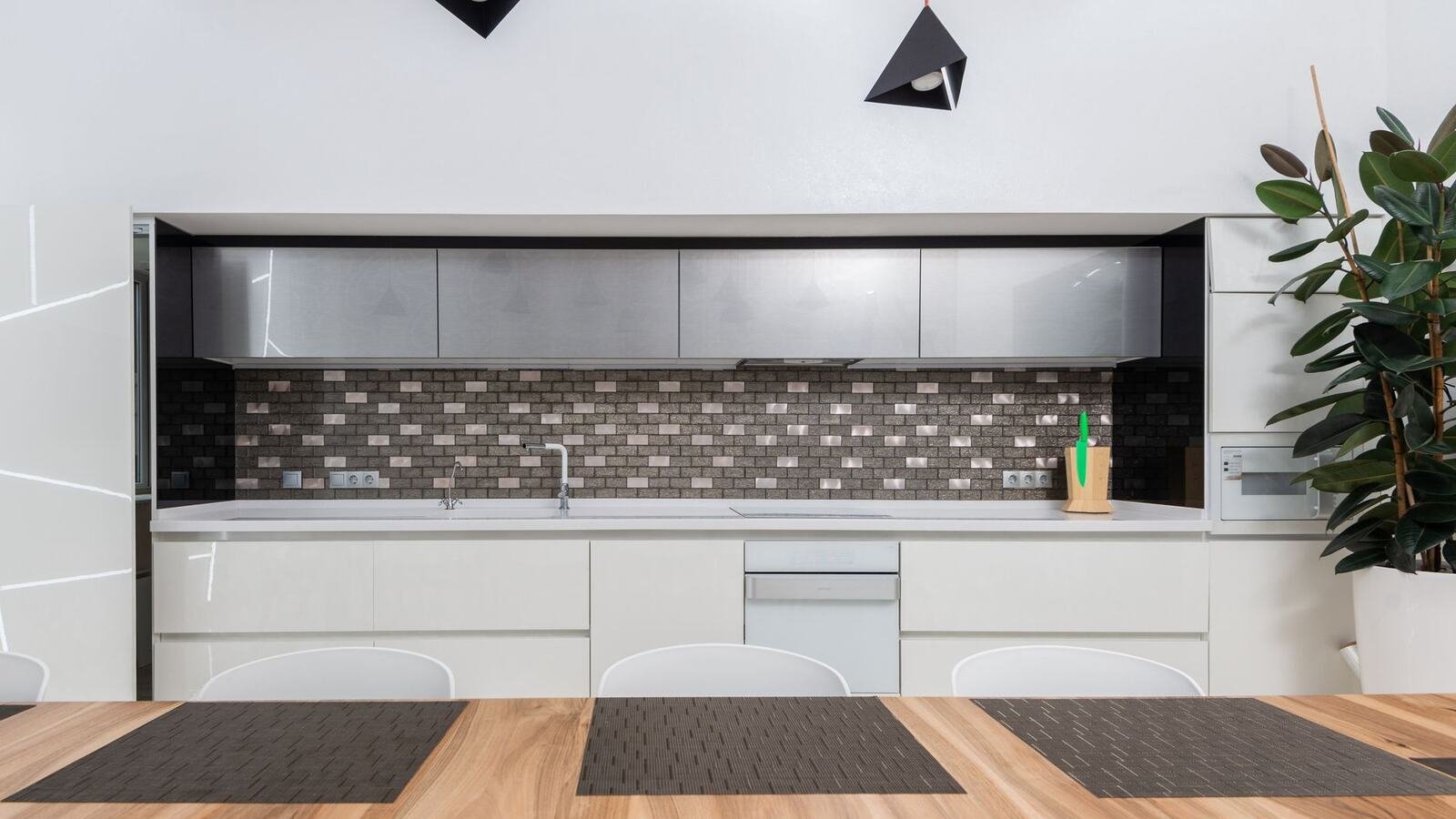
Kitchen tiles in Spain: what to choose, what to avoid
The splashback is the most looked at and most cleaned surface in the home. Almost every regret comes from the grout, not from the tile.
- 48 h
- Fixed written quote within 48 h
- 0 €
- Free site visit
- 6
- On this page
- ★ 5,0
- Google · 13
Short answer
What tile works best behind a kitchen worktop?
Large-format porcelain or a single continuous panel with a 1.5–2 mm joint and epoxy grout behind the hob: fewer joints means less trapped grease and a wipe-down rather than a scrub. Inside a full kitchen renovation in Barcelona — €4,500 to €16,000, with most projects landing near €7,900 and around 18 working days on site — tiling takes two or three days and is one of the few items where paying more for the material barely moves the total, because the labour is already there either way.
The rule behind all of it
Grease collects in the joint, not on the tile. A continuous front wipes clean in one pass; a mosaic needs a brush. Nobody discovers this in a showroom, they discover it a month after moving back in.
The order of decisions
Format first, because it decides how many joints you clean. Then the grout, which decides whether the kitchen ages well. Colour last — the one most people decide first.
Format
Format matters more than colour
| Format | Joints on the splashback | Upkeep | When it makes sense |
|---|---|---|---|
| Continuous panel or large format | None or almost none | One wipe | Flat wall, or wall skimmed first |
| Porcelain 60×60 or similar | Few | Low | Best balance of price and joints |
| Metro 7.5×15 brick-bonded | Many | Medium: the joint stains | Character kitchens on a tight budget |
| Mosaic or glass gresite | A great many | Brush work behind the hob | Rarely a good idea on a work surface |
Tiling up to the wall units
Running the tile up to the underside of the wall units with no mid-height trim strip is the detail that stops a kitchen looking dated. In a period flat with three-metre ceilings there is no point going literally to the ceiling: tile to the unit line, paint the rest in a washable emulsion.
The grout
The cheapest item that decides the result
What to specify
- Epoxy grout on the working splashback: it does not absorb grease or stain
- Grout colour close to the tile, so the wall is not drawn as a grid
- Never white grout behind the hob unless you accept touching it up often
- Flexible sealant — not rigid grout — where tile meets worktop and at internal corners
Where the tile meets the worktop
That line is where water gets in. It is solved with a flexible sealant and treated as a maintenance material: renewed every few years, like a tap washer. Rigid grout in that line always cracks, because the units and the wall do not move together.
What surprises foreign owners
The wall behind the old tiles
Spanish flats keep their kitchen, rarely a usable one
Unlike much of northern Europe the units stay when the flat is sold, but in a 1960s finca they are usually on their last legs, tiled to half height with a decorative border. Budget on the splashback being redone, because it almost always is.
The wall is not flat and large format will not forgive it
A pre-1990 Barcelona building has gypsum render over hollow brick, with a good centimetre of deviation inside a single wall panel. In metro tile you never notice; in a 60×120 slab every dip becomes a visible step at eye level. Either the wall is skimmed first — a real line item — or you go down a format. This is the single most common reason a tiling quote grows on site.
Picar: stripping does not stop where you think
Spanish trades call it picar. Seventies tile is bedded in cement mortar, and taking it off pulls the render with it and exposes bare brick. That is why an honest quote for a pre-1990 flat carries a contingency for substrate repair: it is the work the old tile was hiding.
Where the extraction goes drives the setting out
The hood may vent into the building’s original chimney flue, into a shared shunt duct with a non-return damper, or through a new duct of its own. The facade is a common element of the building, so cutting a new hole in it is a decision for the owners’ meeting and not yours alone. Settle the route before tiling: the hole and the cuts around it get drawn first, or the ugly cut lands in the middle of the wall you look at most.
Deciding from abroad
What to ask for in writing
Make the quote name the substrate
Ask whether the price assumes a flat wall, and what happens if it is not. A quote that says "tiling, X m², Y €/m²" and nothing about skimming is the one that gets revised once the old tile is off and you are 2,000 km away.
Two photographs settle most disputes
- The stripped wall with a straight edge held against it, before any adhesive
- The setting-out marked on the wall, showing where the cut pieces will land
Specify the boring things by name
Tile reference and finish, grout type and colour, joint width in millimetres, and whether external corners are mitred or trimmed. Four lines that cost nothing to write and remove the four arguments that actually happen.
Frequently asked
Common questions
Large-format porcelain or a continuous panel, because it keeps joints to a minimum and wipes clean in one pass. Behind the hob the grease collects in the joint rather than on the tile, and that is where the weekly work is.
Yes on the working splashback: it does not absorb grease or stain, and the extra cost is small next to redoing yellowed joints after two years. On the rest of the wall a good cement-based grout is enough.
Only if the wall is checked with a straight edge first. Old gypsum render typically deviates by a centimetre, and on a big slab every dip shows as a step. Either the wall is skimmed beforehand, which is a separate line item, or you choose a smaller format.
For the duct route, often yes. The facade is a common element of the building, so cutting a new opening in it is decided by the owners’ meeting and may be refused in a protected building. Venting into the original chimney or a shared shunt with a non-return damper is usually the simpler route.
Yes, with the right adhesive on a clean, degreased surface, and it saves dust, rubble and disposal cost. The splashback gains thickness, so sockets sit deeper and sometimes need extension boxes.

Next step
Want a figure for your own project?
Free site visit in Barcelona and the metropolitan area. Fixed written quote within 48 hours, no obligation.
More articles
Keep reading
Bathroom costs
The most asked question and the worst answered. Here is the breakdown by trade, not a showroom figure.
Comparing quotes
The cheapest quote is rarely the cheapest. It is the least complete, and the difference appears when you can no longer change contractor.
Buying to renovate
The problems that make a renovation expensive are visible before you buy — if you know where to look. Most buyers do not.
Price per m²
Price per square metre is the most quoted and least defined figure in the trade. Two firms can both say the same number and be describing completely different projects.
Other services
We also do
Clients
What clients say after their renovation
Rated 5.0 from 14 Google reviews. All real, from real projects.
★★★★★
“Doy un 10 la verdad con el servicio que me han prestado en una reforma de un piso en Barcelona capital, gente muy seria y responsable, gracias.”
Araks SahakyanJuly 2026
★★★★★
“Quedé encantada con la atención y la calidad del trabajo. Se nota que cuidan los detalles y cumplen con lo que prometen.”
Ana RiveraApril 2026
★★★★★
“Servicio muy profesional. Me explicaron todo con claridad y el trabajo quedó perfecto.”
Ana AlemanMarch 2026
★★★★★
“Si estas buscando profesionales responsables para hacer tu reforma, es el lugar indicado. Especializados en reformas integrales con la mejor atención personalizada. 100% recomendados.”
Daniel GarganoFebruary 2026
★★★★★
“Muy buen trabajo, ha realizado un trabajo muy profesional, ha cumplido en plazo y en calidad.”
Francisco PiñeirosAugust 2025
★★★★★
“Muy buenos profesionales, con excelente resultado.”
Esther DiezJune 2026
Want a figure for your own project?
Free site visit and a fixed written quote within 48 hours.
+34 615 78 93 41· Carrer de la Diputació, 189, Local 2 · 08011 Barcelona