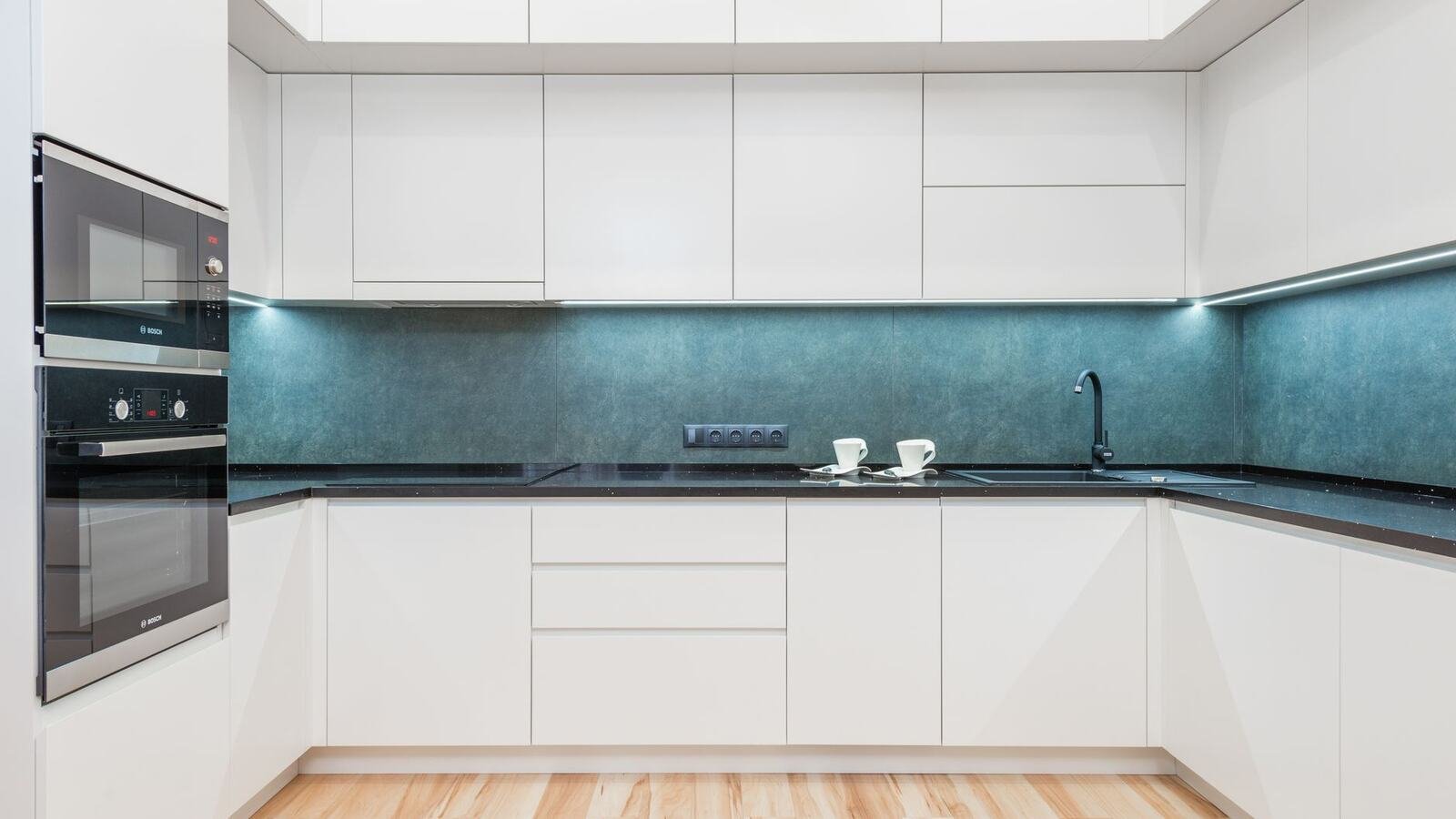
Kitchen sink types: which one to choose
The sink is decided before the worktop, not after: the mounting type dictates which worktop materials are possible and how the stone shop cuts it.
- 48 h
- Fixed written quote within 48 h
- 0 €
- Free site visit
- 6
- On this page
- ★ 5,0
- Google · 13
Short answer
What sink types are there and how do you choose?
Kitchen sinks are classified by mounting and by material. There are three mountings: overmount, which sits on the worktop with a visible rim and works with any surface including laminate; undermount, bonded underneath with no rim, which requires a solid worktop such as granite, quartz, compact or porcelain; and flush-mounted, machined into the worktop so both sit at the same level. By material, stainless steel is the most versatile and lightest, composite granite the most resistant to knocks and scratches, and ceramic the best looking but the most fragile. Choose it before ordering the worktop, because the mounting decides the cut and the fabricator’s price. In a full kitchen renovation — €4,500 to €16,000 and 12–25 working days — the sink has to be signed off in week one.
It is often decided last, with the units already ordered — and by then there is no room left to correct anything.
Mounting
Overmount, undermount and flush compared
| Mounting | How it looks | Compatible worktop | Cleaning |
|---|---|---|---|
| Overmount (sobre encimera) | Visible rim resting on the worktop | Any, laminate included | You have to sweep water over the rim |
| Undermount (bajo encimera) | Bonded underneath, worktop edge on show | Solid only: granite, quartz, compact, porcelain | Water sweeps straight into the bowl |
| Flush or integrated (enrasado) | Level with the worktop, thin perimeter joint | Solid, machined to a rebate in the workshop | Very comfortable, but the joint needs attention |
Overmount
The advantage the table does not show: replacing it years later does not mean touching the worktop.
Undermount
On a solid worktop it wins on cleaning. On laminate it is not an option, and the damage is not a repair: the board gets replaced.
Flush or integrated
The most expensive and the least forgiving: the margin for error is tiny, and the worktop is ordered with the sink already bought.
Materials
Stainless steel, composite granite and ceramic
| Material | Strengths | Weaknesses | Pairs well with |
|---|---|---|---|
| Stainless steel | Light, hygienic, takes all three mountings, will not crack | Scratches with use and shows limescale spots | Any worktop; essential if the worktop is laminate |
| Composite granite | Very resistant to impact, heat and scratching; damps water noise | Pale tones can stain from tea, wine or coffee if left | Quartz, compact and porcelain worktops |
| Ceramic or fireclay | Presence and a noble finish, very easy to wipe clean | Heavy, brittle under a sharp knock, glaze can chip | Classic or rustic kitchens, overmount fitting |
Stainless steel
What matters is the gauge, not the alloy grade: thin steel drums under running water and dents when a pan lands. Micro-textured finishes hide scratches far better than a polish.
Composite granite
Barcelona water is hard, so dark tones show limescale; pale ones are more sensitive to tea, wine and coffee if left to sit.
Ceramic
Its weak point is the glaze: a knock from a cast-iron pan chips it, and that repair shows. Watch the weight too — the base unit has to be built for it.
Old flats
What changes in a period Barcelona flat
In the Eixample or Gràcia the kitchen is usually a narrow galley ending in a glazed gallery. That geometry, not the catalogue, decides your sink.
The 60 cm base unit rules
In a galley kitchen the sink cabinet is very often 60 cm, and no wider slot exists to move into. At that width a double bowl means two bowls too small to be useful.
The old cast-iron stack sets your drain height
Period flats drain into a cast-iron stack (bajante) owned by the comunidad, and the fall to your branch is whatever it is. An undermount bowl sits a couple of centimetres lower, and with the trap and the dishwasher hose on the same connection, those centimetres decide whether it empties or gurgles.
Moving the sink is plumbing, not furniture
It looks like a line on a plan and is plumbing: hot and cold extended, the waste rebuilt with fall and, if the branch crosses the kitchen, the floor lifted over hydraulic mosaic you cannot buy again.
Water pressure and the tap
With the modest pressure in older buildings, a tall spout with a pull-out spray weakens when extended. Under a gallery window, check the tap opens fully without hitting the frame.
Bowls and sizes
How many bowls, and what fits the cabinet
The trend is a single large bowl, and in a Barcelona galley kitchen there is rarely a choice.
When each option makes sense
- Single large bowl: the default with a dishwasher, no divider in the way
- Bowl and a half: a small well to defrost, drain or soak off the main bowl
- Two equal bowls: only without a dishwasher, as they steal working front
- Bowl with a drainer wing: comfortable, but it costs half a bowl of space
The cabinet-width rule
The sink suits the cabinet, not the reverse: 60 cm takes a single bowl of about 50, 80 cm a bowl and a half, 90 cm two bowls or one large bowl with a drainer.
What to check before buying
- Bowl depth: 18–20 cm is standard; deeper gains capacity but means stooping
- Clear space under the bowl for the trap, dishwasher waste and any filter
- Distance to the wall so the tap opens fully
- Number of tap holes: mixer, soap dispenser or waste control
The right order
Cabinet first, then sink and tap, and only then the worktop templated: with the sink in hand the cut is right first time, and otherwise you pay for the adaptation.
Frequently asked
Common questions
Stainless is lighter and cheaper to replace but scratches and shows limescale; composite granite handles knocks better and is quieter under running water. With a laminate worktop, overmount stainless is the sensible answer.
It is not advisable: undermounting leaves the cut edge of the board exposed to moisture and it swells. On laminate the correct mounting is overmount, whose rim covers and protects the cut.
With a dishwasher, one large bowl works better: it takes the oven tray and cleans more easily. Two make sense without a dishwasher or on a long worktop. In a 60 cm cabinet a single bowl is realistically the only option.
As a reference, a single bowl around 50 cm wide, leaving clearance either side for the cut and the hinges. Measure the clear internal space rather than the door front, because panels vary between manufacturers.
It is plumbing rather than furniture: hot and cold extended, and the waste rebuilt with enough fall to reach the communal stack (bajante). In a period building that often means lifting the floor, and original hydraulic mosaic tiles cannot be replaced.

Next step
Want a figure for your own project?
Free site visit in Barcelona and the metropolitan area. Fixed written quote within 48 hours, no obligation.
More articles
Keep reading
Catalan vault floors
If your Barcelona flat predates the 1950s, the floor under your feet is almost certainly a Catalan vault. It is not a defect — it is the system that holds up the Eixample. But it decides half of your renovation before you draw a plan.
Microcement
It is in every design magazine and half of all quote requests. It earns its reputation — but only applied well, in the right places, on the right substrate. And in a Barcelona period building, the substrate is in charge.
Custom wardrobes
The first surprise for most foreign buyers: Spanish flats are usually sold with no wardrobes at all. The second: the joinery you add is opened and closed thousands of times a year, and it is where badly placed savings show fastest.
Painting a flat
The cheapest trade with the biggest visual return — and the one where the quote hides the most, because everything that matters happens before the roller touches the wall.
Other services
We also do
Clients
What clients say after their renovation
Rated 5.0 from 14 Google reviews. All real, from real projects.
★★★★★
“Doy un 10 la verdad con el servicio que me han prestado en una reforma de un piso en Barcelona capital, gente muy seria y responsable, gracias.”
Araks SahakyanJuly 2026
★★★★★
“Quedé encantada con la atención y la calidad del trabajo. Se nota que cuidan los detalles y cumplen con lo que prometen.”
Ana RiveraApril 2026
★★★★★
“Servicio muy profesional. Me explicaron todo con claridad y el trabajo quedó perfecto.”
Ana AlemanMarch 2026
★★★★★
“Si estas buscando profesionales responsables para hacer tu reforma, es el lugar indicado. Especializados en reformas integrales con la mejor atención personalizada. 100% recomendados.”
Daniel GarganoFebruary 2026
★★★★★
“Muy buen trabajo, ha realizado un trabajo muy profesional, ha cumplido en plazo y en calidad.”
Francisco PiñeirosAugust 2025
★★★★★
“Muy buenos profesionales, con excelente resultado.”
Esther DiezJune 2026
Want a figure for your own project?
Free site visit and a fixed written quote within 48 hours.
+34 615 78 93 41· Carrer de la Diputació, 189, Local 2 · 08011 Barcelona