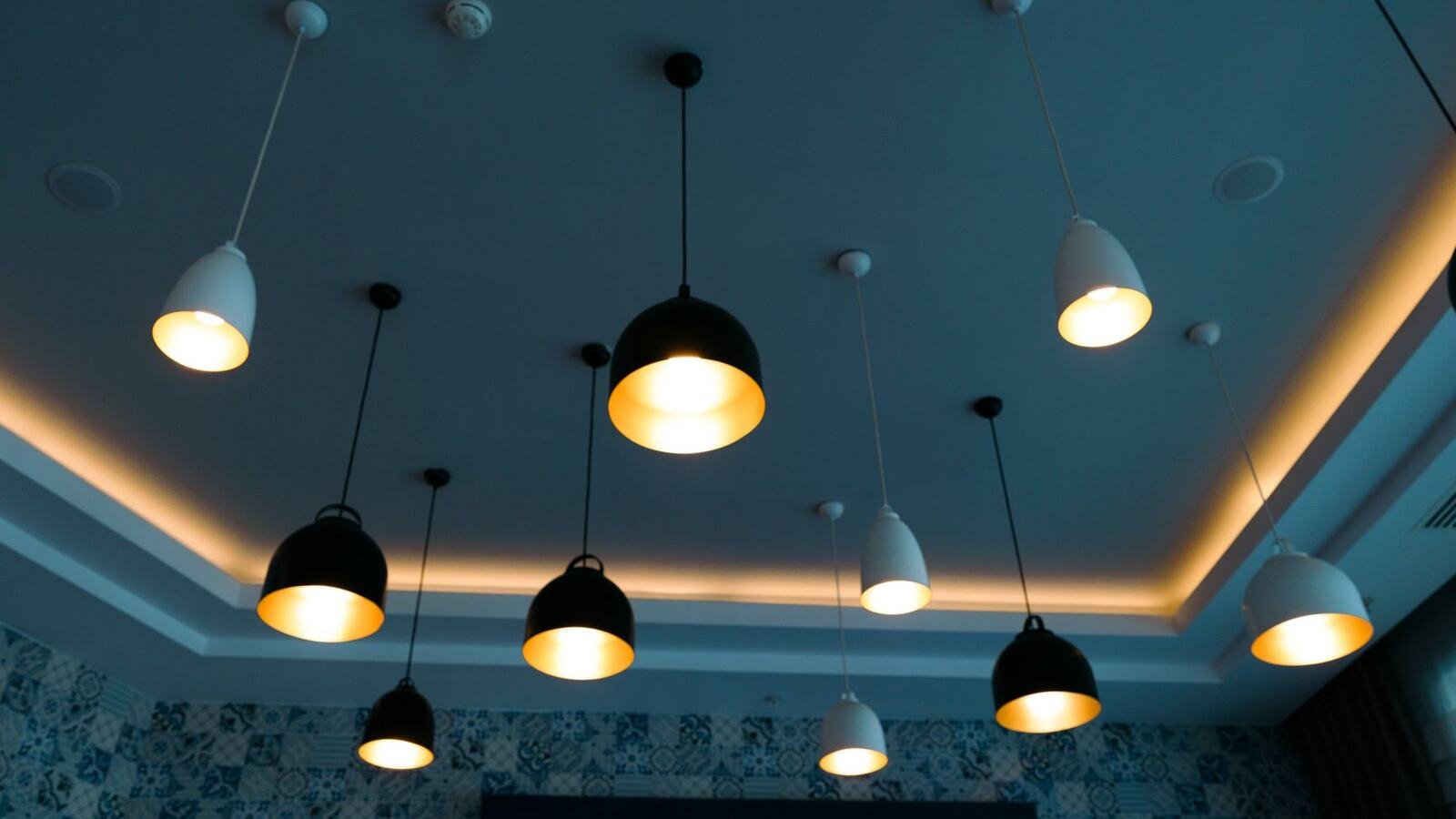
Lighting: decided on site, not afterwards
Lighting transforms a home more than any finish does, and it is the thing owners most often regret not having thought about while there was still time to change it.
- 48 h
- Fixed written quote within 48 h
- 0 €
- Free site visit
- 5
- On this page
- ★ 5,0
- Google · 13
The essentials
How many circuits each room needs
Decide the light points, the circuits and the dimming before the chases are closed. While the walls are open a light point or a socket costs €30–60, and rewiring a whole flat runs €4,000–7,500 inside the same 10–14 week programme. Afterwards the identical point means chasing out finished plaster and redecorating, and a full repaint of an 80 m² flat is €1,400–2,400. Colour temperature is the exception: it costs nothing to correct, because you simply change the lamp.
| Decision | Deadline on site | Cost now | Cost once the walls are closed |
|---|---|---|---|
| Extra light point or socket | First fix, before plastering | €30–60 each | Chasing, making good and repainting the room |
| Separate circuits per lighting layer | When the consumer unit is set out | Cable and switch inside the electrical line item | A new run from the consumer unit through a closed ceiling |
| Two-way switching at the bed and hallway | Before partitions close | One more wire in the same conduit | A chase from one end of the room to the other |
| Dimming | When switches are chosen | A small difference in accessory cost | New circuit plus a dimmable driver for the strip |
| LED strip in a cove or headboard | On the ceiling drawing | Supply and neutral left in place | Rebuilding a painted plasterboard cove |
| Mirror lighting in the bathroom | Before tiling | Box and conduit behind the tile | Cutting into laid tile you can no longer match |
| Colour temperature, 2700–3000 K | Any time | Nothing — it is a specification | Nothing: change the lamp, the cheapest fix in the flat |
A single switch per room forces you to turn everything on or everything off. It is the most common lighting mistake and the easiest one to avoid during the work, because the cost of avoiding it is close to zero at the right moment.
Sensible minimums
- Living room: three or four circuits — general, ambient, reading and decorative
- Kitchen: three — general, worktop and under-cupboard ambient
- Bedroom: two, plus a point at each bedside with its own switch
- Bathroom: two — general and mirror, the mirror lit from the front rather than overhead
- Hall and entrance: one, with presence detection where possible
Why it costs almost nothing now
The cable and the switch are a few euros per point. The expensive part is the chase in the wall, and it is already open. Adding a circuit afterwards means cutting into finished plaster, repainting, and in many cases lifting flooring — which is how a twenty-euro decision becomes a four-hundred-euro one.
Colour temperature
The number that decides the atmosphere
Colour temperature changes the feel of a home more than any other single variable, and getting it right costs nothing at all — it is purely a matter of specifying the correct lamp.
What to use where
- 2700 K, warm: living rooms, bedrooms, anywhere for relaxing. This is what reads as domestic
- 3000 K, warm neutral: bathrooms and kitchens, where you need to see clearly without coldness
- 4000 K, neutral: work areas, garage, storage
- Above 5000 K: technical use only. In a home it produces an office atmosphere
The rule almost nobody follows
Use one temperature throughout the home, or at minimum one per zone. Mixing 2700 K and 4000 K in the same room is what makes a newly renovated flat look subtly wrong without anyone being able to say why. It is also, mercifully, the cheapest mistake to correct — you change the lamps.
A note for owners of period flats
In a Barcelona flat with hydraulic floor tiles, mouldings and high ceilings, cool light is actively destructive to the character you paid for. Those materials were made to be seen under warm light, and at 4000 K they look grey and flat. This is worth insisting on if a contractor defaults to a cooler lamp because it measures brighter.
Mistakes
What goes wrong most often
Downlights in a grid
Distributing recessed spots symmetrically across the ceiling lights the floor rather than the things you need to see. Put them where light is actually required: over the worktop, beside the sofa, in front of the wardrobe. A symmetrical grid looks organised on a plan and performs poorly in the room.
Overhead light in the bathroom
A downlight in the ceiling above the mirror casts shadows down the face — exactly the opposite of what a mirror is for. Mirror lighting has to be frontal or lateral, at face height. This single error is responsible for more complaints about a finished bathroom than tile choice ever is.
No provision for dimming
A living room with one fixed level at full output is no good for watching television and no good for eating. Allowing for dimming during the work costs the price of the switch mechanism.
Badly concealed LED strip
A strip without a diffuser, or poorly hidden, reads as a row of bright dots instead of a continuous line. An aluminium profile with a diffuser is inexpensive and is the entire difference between a professional result and something that looks improvised.
Deciding remotely
Specifying lighting when you are not there
Lighting is unusually well suited to being decided from a distance, because almost all of it can be fixed on a drawing before anything is built. What it does not tolerate is being left until the site asks.
What to settle before first fix
- A reflected ceiling plan showing every light point and which circuit it belongs to
- The colour temperature, stated in kelvin, for every area
- Which circuits are dimmable, since that affects both driver and switch selection
- Switch positions, which are worth checking against how the furniture will actually be arranged
The moment that matters
First fix — when the cables are pulled and before the walls are closed — is the deadline for all of it. After that, every change has a demolition cost attached. Ask to be sent the lighting plan for approval before first fix begins, not after, and treat that as a fixed appointment in the programme rather than a courtesy.
Where automation genuinely earns its place
A basic smart set-up with scenes and remote control starts around €1,900, and for an owner who is not in the country it does something specific and useful: lights that come on in a pattern make an empty flat look occupied. That is a security argument rather than a comfort one, and it is the most common reason our remote clients ask for it.
Frequently asked
Common questions
At least three independent circuits: general, ambient and reading. With a single switch you can only turn everything on or off, and it is one of the most frequently regretted decisions in a finished renovation.
2700 K in living areas and bedrooms, 3000 K in bathrooms and kitchens. Above 4000 K a home starts to feel like an office. The most important rule is not to mix temperatures within the same room.
You can, but it means cutting finished walls, repainting and sometimes lifting flooring. During the work the cost per point is marginal because the chases are already open — afterwards it is roughly twenty times as much.
If they are positioned where light is needed, yes. Spread in a symmetrical grid they illuminate the floor and leave the places you actually need to see in relative shadow.
In living rooms and bedrooms, clearly. It lets one installation serve both working light and evening light without changing fittings. Specified during the work it costs little more than a standard switch.

Next step
Want a figure for your own project?
Free site visit in Barcelona and the metropolitan area. Fixed written quote within 48 hours, no obligation.
More articles
Keep reading
Cove lighting
Walk into a well-renovated Barcelona flat at dusk and the light seems to come from nowhere. That is a foseado — and it is decided before the ceiling closes, not after.
Wood in wet rooms
Continuous wood through the whole flat is a legitimate design decision. The problem is not the wood — it is the day a flexible hose starts weeping behind a unit while nobody is in the flat.
Rustic modern bathrooms
Rustic modern works when the texture is real and the shapes are current. Spanish period flats start with an advantage: part of the texture is already in the building.
Pladur headboards
In Spain the word pladur means plasterboard, and a pladur headboard is where the light, the sockets and the bedside storage end up — with no cables on the floor.
Other services
We also do
Clients
What clients say after their renovation
Rated 5.0 from 14 Google reviews. All real, from real projects.
★★★★★
“Doy un 10 la verdad con el servicio que me han prestado en una reforma de un piso en Barcelona capital, gente muy seria y responsable, gracias.”
Araks SahakyanJuly 2026
★★★★★
“Quedé encantada con la atención y la calidad del trabajo. Se nota que cuidan los detalles y cumplen con lo que prometen.”
Ana RiveraApril 2026
★★★★★
“Servicio muy profesional. Me explicaron todo con claridad y el trabajo quedó perfecto.”
Ana AlemanMarch 2026
★★★★★
“Si estas buscando profesionales responsables para hacer tu reforma, es el lugar indicado. Especializados en reformas integrales con la mejor atención personalizada. 100% recomendados.”
Daniel GarganoFebruary 2026
★★★★★
“Muy buen trabajo, ha realizado un trabajo muy profesional, ha cumplido en plazo y en calidad.”
Francisco PiñeirosAugust 2025
★★★★★
“Muy buenos profesionales, con excelente resultado.”
Esther DiezJune 2026
Want a figure for your own project?
Free site visit and a fixed written quote within 48 hours.
+34 615 78 93 41· Carrer de la Diputació, 189, Local 2 · 08011 Barcelona