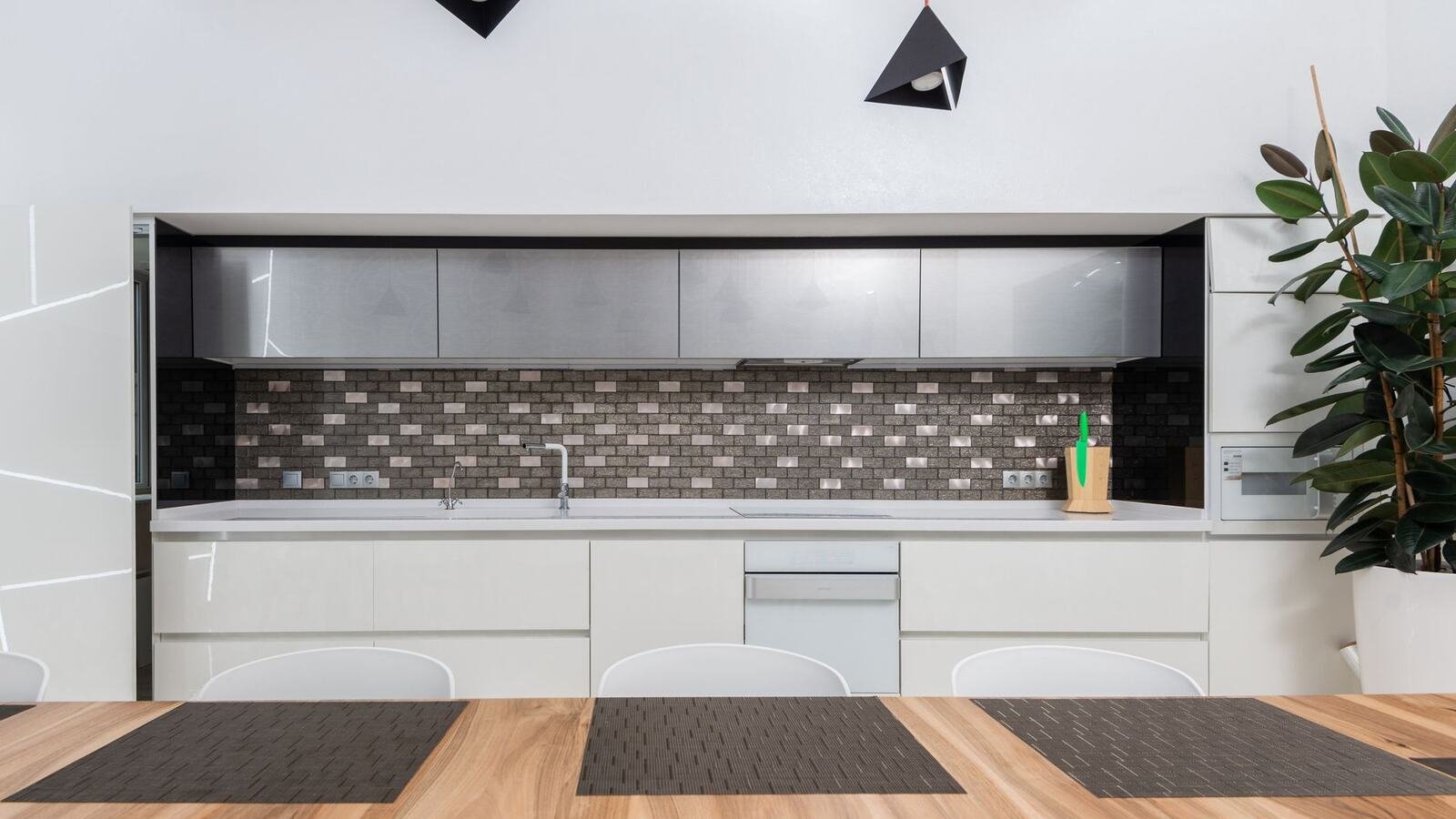
Wood floors in Spanish kitchens and bathrooms
Continuous wood through the whole flat is a legitimate design decision. The problem is not the wood — it is the day a flexible hose starts weeping behind a unit while nobody is in the flat.
- 48 h
- Fixed written quote within 48 h
- 0 €
- Free site visit
- 5
- On this page
- ★ 5,0
- Google · 13
Short answer
Can you lay wood in the kitchen and bathroom?
In the kitchen yes, with conditions: engineered wood with sealed perimeter joints handles normal use and splashes. In the bathroom’s wet zone the honest answer is no — standing water works the boards until they cup or lift. For visual continuity the sensible answer is wood-look porcelain, which has no limitation around water at all. And bathroom floors never travel alone in Spain: they are replaced inside the full renovation, €3,200–9,500 and 10–18 working days, while a complete kitchen runs €4,500–16,000.
The distinction that settles every argument: getting wet is not the same as staying wet. A well-finished wood floor tolerates water that falls and dries; it does not tolerate the slow leak nobody sees for weeks.
Comparison
What each material tolerates, zone by zone
| Zone | Engineered wood | Laminate | Wood-look porcelain |
|---|---|---|---|
| Living room and bedrooms | Ideal — its natural territory | Fine, quality depending | Valid, colder underfoot |
| Kitchen, walking zone | Good, with sealed joints | Water-resistant ranges only | No limitations |
| Kitchen, sink and dishwasher front | Risk zone: where slow leaks appear | Not advisable | No limitations |
| Bathroom, dry zone | Possible, accepting maintenance and risk | No | No limitations |
| Bathroom, shower zone | No | No | The correct answer |
| Galeria (utility gallery) | No: condensation, washing machine, drying rack | No | No limitations |
Engineered wood
A real hardwood wear layer over a stratified core — far more stable through humidity swings than solid wood, and the only one of the three with a second life: it can be sanded and refinished instead of replaced.
Laminate
Not wood: a fibreboard core under a printed image. Its weak point is the edge — once water enters the joint, the core swells and the swelling never reverses. Water-resistant ranges last longer, but in wet zones it remains the worst of the three.
Wood-look porcelain
Current long-plank formats with texture synchronised to the print are hard to tell from wood at a metre away. Waterproof, zero maintenance, and the best heat conductor if there is underfloor heating. The trade-off: colder underfoot and a different sound underfoot.
Spanish specifics
What Spanish flats add to the question
What sleeps under the old floor
In flats renovated in the nineties, floating floors were often laid straight over hydraulic mosaic — the patterned cement tiles of period buildings. Before choosing a new floor, lift a corner: a recoverable mosaic can be polished into a finish no catalogue sells. If you keep it underneath, never glue on top of it — floating is reversible, adhesive is not.
The galeria is not the kitchen
The glazed gallery behind many Spanish kitchens is the dampest room in the flat: condensation on the glass, the washing machine, the drying rack. Even if the kitchen gets wood, the galeria wants porcelain — and the doorway between them is the natural place for the transition.
A leak travels downstairs
Under a period flat’s floor sits a timber or ceramic-vault structure, and below it a neighbour’s ceiling. A slow leak that a floating floor hides for weeks ends as a stain in the flat below — and Spanish home insurance and the community get involved. In water-adjacent zones, glued installation behaves better: there is no cavity for water to move through unseen.
Levels and doors
Old buildings accumulate screeds: each past renovation left its thickness and rooms rarely share a level. New wood raises the floor one or two centimetres — doors get trimmed, but the step against bathroom or hallway must be resolved on the plan, not with a three-colour profile mid-corridor.
Remote owners
Deciding and verifying from abroad
The rented-flat calculation
If the flat is let, the material choice is also a management choice: laminate’s swollen edges after a tenant’s minor flood mean replacing the room; porcelain shrugs it off; engineered wood survives if the water is caught early — which, from another country, it rarely is. For rental stock, wood-look porcelain is the answer that never calls you at 2 a.m.
What to ask for in writing
- Moisture reading of the screed before laying — new screeds hold residual water for weeks
- Days of acclimatisation: boards must sit in the flat before installation
- Perimeter joints sealed with neutral silicone under the skirting — the most common water entry
- A photo of what appeared under the old floor before it is covered: mosaic, old repairs, damp marks
- If underfloor heating: the manufacturer’s thermal-resistance sheet for the exact product
The continuity compromise
Wood in living rooms, bedrooms and hallway; matched-tone porcelain in kitchen, bathrooms and galeria. Flush transitions with minimal profiles read as design; thick trims and steps read as a patch. Most owners who wanted “wood everywhere” actually wanted this.
Frequently asked
Common questions
Not in the wet zone: standing water works the boards until they cup or lift, and there is no satisfying repair. In a large bathroom with a genuinely separate dry zone it is possible if you accept the maintenance and the risk — but for visual continuity, wood-look porcelain is the sensible answer.
Laminate is a fibreboard core under a printed image: no visible wood, cannot be sanded, and edge swelling from water never reverses. Engineered wood carries a real hardwood layer over a stable core, tolerates humidity swings better and can be sanded and refinished.
Floating, yes — and it is reversible, the mosaic stays protected underneath. Glued, never: it destroys a floor that cannot be repurchased. Before covering it, consider recovering it — polished hydraulic mosaic is a finish no catalogue offers.
Porcelain conducts heat best. Engineered wood is compatible with the right thickness and species — the manufacturer states the maximum thermal resistance. With laminate, check the product sheet: not every range is certified for underfloor heating.
Wood-look porcelain in kitchen, bathrooms and galeria, and either porcelain or engineered wood in the rest. A tenant’s unnoticed leak that ruins laminate in a week leaves porcelain untouched — and in a building with neighbours below, the floor that hides water longest is the most expensive one.

Next step
Want a figure for your own project?
Free site visit in Barcelona and the metropolitan area. Fixed written quote within 48 hours, no obligation.
More articles
Keep reading
Realistic timelines
Almost every overrun we see was decided before the first wall came down. The programme is not broken on site — it is broken at the ordering stage.
Costly mistakes
None of these mistakes has anything to do with taste. Every one of them is about the order in which things were done.
Energy certificate
Every flat advertised for sale or rent in Spain must display an energy letter. Most owners treat it as a formality — until they discover which works would have changed it.
Damp problems
Painting over damp costs you money twice: the paint, and then the repair you should have done first. Everything depends on which of the four it is.
Other services
We also do
Clients
What clients say after their renovation
Rated 5.0 from 14 Google reviews. All real, from real projects.
★★★★★
“Doy un 10 la verdad con el servicio que me han prestado en una reforma de un piso en Barcelona capital, gente muy seria y responsable, gracias.”
Araks SahakyanJuly 2026
★★★★★
“Quedé encantada con la atención y la calidad del trabajo. Se nota que cuidan los detalles y cumplen con lo que prometen.”
Ana RiveraApril 2026
★★★★★
“Servicio muy profesional. Me explicaron todo con claridad y el trabajo quedó perfecto.”
Ana AlemanMarch 2026
★★★★★
“Si estas buscando profesionales responsables para hacer tu reforma, es el lugar indicado. Especializados en reformas integrales con la mejor atención personalizada. 100% recomendados.”
Daniel GarganoFebruary 2026
★★★★★
“Muy buen trabajo, ha realizado un trabajo muy profesional, ha cumplido en plazo y en calidad.”
Francisco PiñeirosAugust 2025
★★★★★
“Muy buenos profesionales, con excelente resultado.”
Esther DiezJune 2026
Want a figure for your own project?
Free site visit and a fixed written quote within 48 hours.
+34 615 78 93 41· Carrer de la Diputació, 189, Local 2 · 08011 Barcelona